
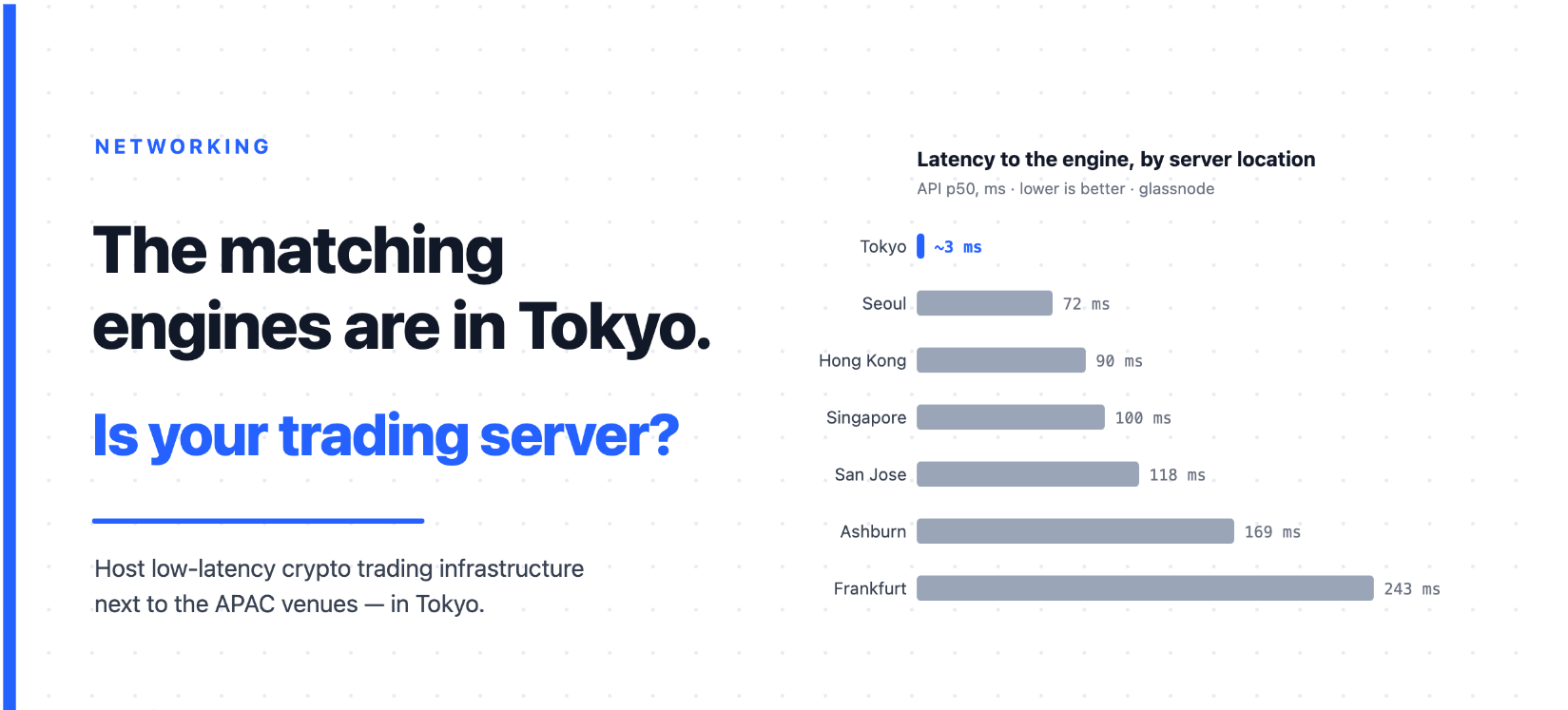
Your fills might be worse than your strategy deserves — and the reason could be geography, not code. If your trading server sits in the US or Europe while the matching engine sits in Tokyo, every order crosses an ocean before it lands. On the venues where Asian volume concentrates, that round trip is the difference between the top of the book and the leftovers.
The APAC matching engines live in one place
Most of the crypto venues that matter in Asia run their matching engines in the same region: AWS Tokyo, ap-northeast-1. Binance, Bitget, KuCoin, HTX, CoinEx, MEXC, and Hyperliquid all concentrate critical infrastructure there. This means Tokyo has quietly become the default hub for digital-asset trading in the region. Therefore, the shortest path to a fill runs through Tokyo — not through wherever your box happens to live.
In trading, the distance is the edge
This latency isn't user-experience polish. It's money. Look at measured API latency to Hyperliquid, a major venue running in AWS Tokyo, by where the server sits: from Tokyo, single-digit milliseconds; from Seoul, ~72 ms; Hong Kong, ~90 ms; Singapore, ~100 ms; the US, 120 ms and up; Europe, north of 200 ms. At those gaps the closer book wins the fill, the tighter quote, and the arb every time. And the drop-off is a cliff: even Seoul and Singapore, the next-closest hubs, sit 20–40× behind a Tokyo box.
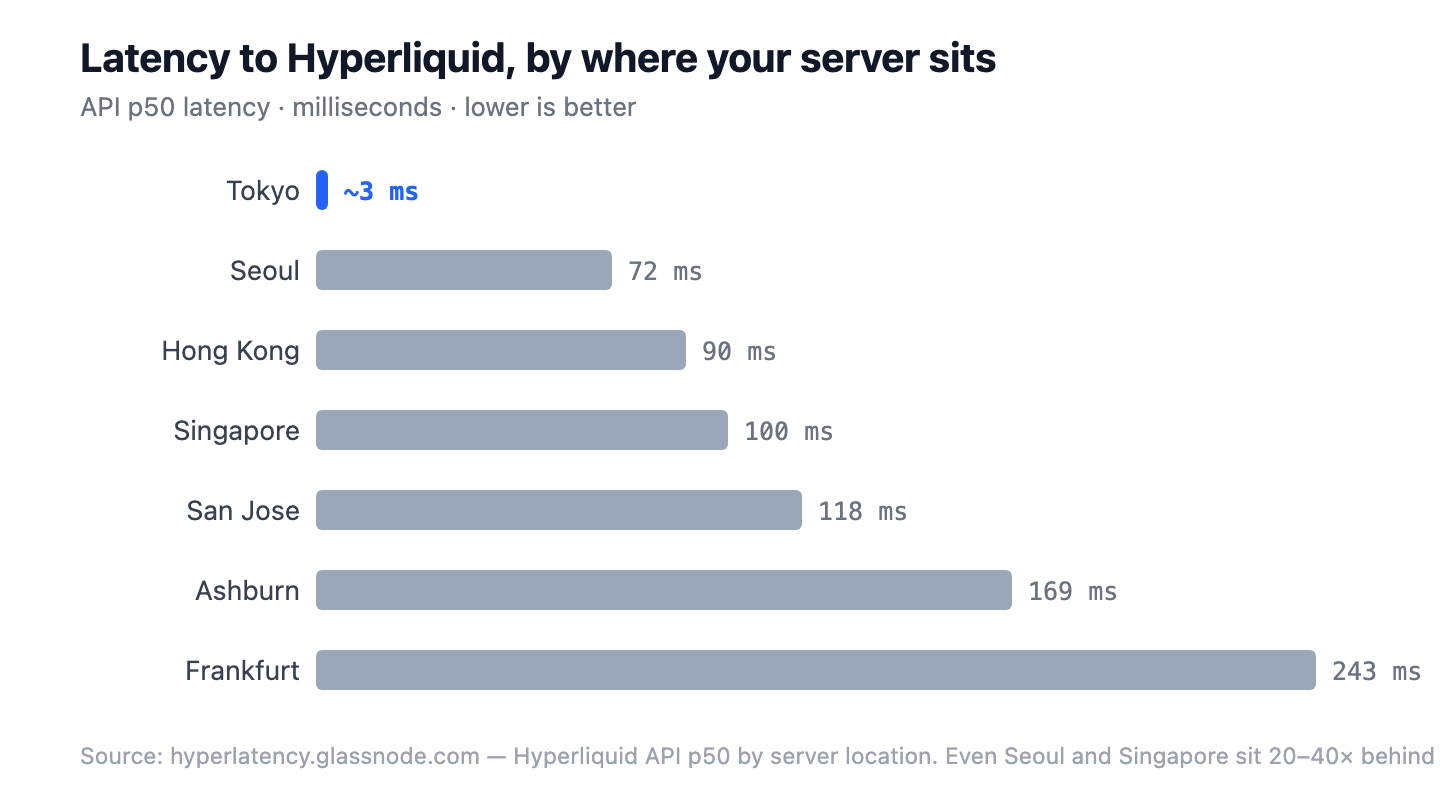
Hyperliquid API p50 latency by server location — source: hyperlatency.glassnode.com. Lower is better. Even Seoul and Singapore — the next-closest hubs — sit 20–40× behind a Tokyo box.
The fix isn't a faster server — it's a shorter path
You can't outrun physics. Getting close comes down to two things: where the server sits, and how directly it reaches the venue. And "Tokyo" alone isn't precise enough. Within the metro, which facility and zone you land in swings latency from ~3 ms to ~20 ms, a 6–7× spread for servers all technically "in Tokyo."
What you want is a box in the same Tokyo metro as the venue's AWS region, reaching it over a network that peers straight into that region rather than routing best-effort across the public internet — a short hop, not an ocean crossing.
The edge is the network
Trading is bandwidth-heavy: market data in, orders out, constantly. Cloud egress is metered by the gigabyte — AWS charges about $0.09/GB — so a strategy moving tens of terabytes a month runs up thousands of dollars in transfer alone. Zenlayer Tokyo compute moves the same data at $0.017/GB, roughly a fifth of the price, and the gap widens with every terabyte you push.
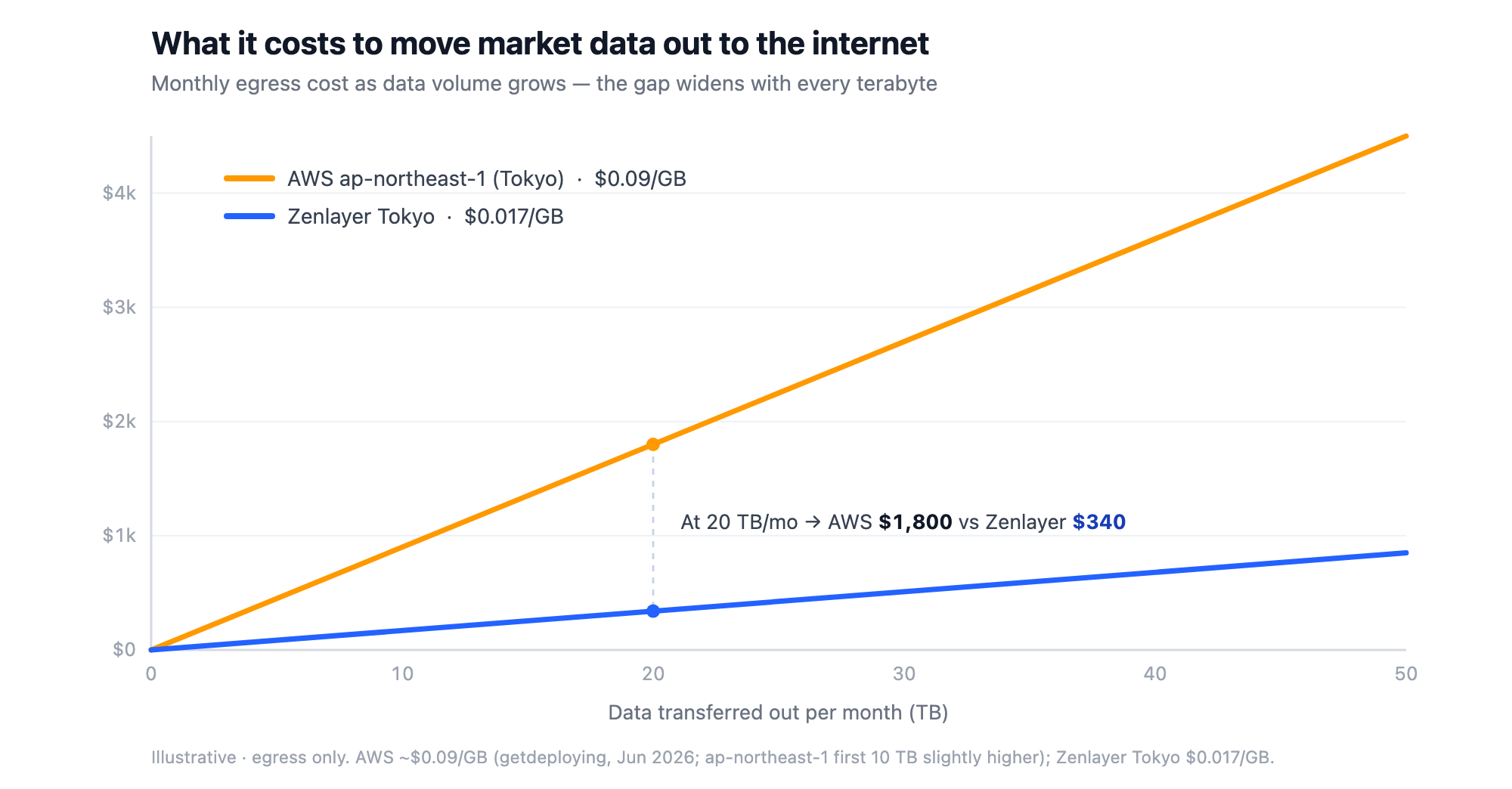
A desk pulling full order-book and tick data across venues clears tens of terabytes a month — the range where the egress gap turns into real money.
The compute is cheaper, too: a comparable Zenlayer instance (8 vCPU / 16 GB) lists around $106/mo against roughly $248 for the equivalent EC2 — about half the price (getdeploying, Jun 2026).
And you stay independent. Run your box inside the venue's own cloud region and one region event takes out your infrastructure and the venue together, on a single cloud. A neutral network in the same metro stays separable and reaches other venues and clouds the same way — dedicated bare metal, on a Tokyo network built to carry the traffic, with the consistency and the economics trading actually runs on.
Who this is for
Anyone whose fills depend on APAC venues: market makers, algo and HFT desks, trading-bot operators, quant funds, and smaller exchanges that need to sit near the liquidity. The one honest caveat — if the only venue you trade is in the US or Europe, host near that engine instead. Proximity is venue-specific. This is the play when the matching engine you care about is in Tokyo.
Why Zenlayer Tokyo
It isn't just a server in Tokyo — it's a server in the same metro as the venue, on a network that peers straight into it:
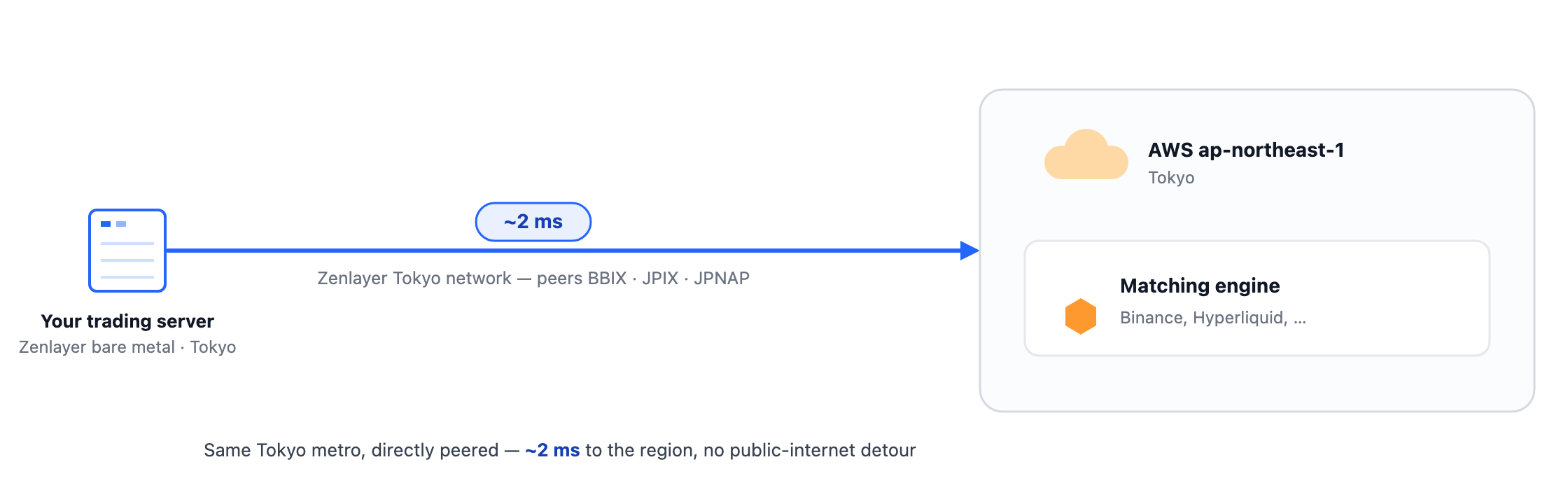
A Zenlayer bare-metal server sits in the same Tokyo metro as ap-northeast-1 and reaches it in about 2 ms (Zenlayer last-mile performance monitoring), peering directly at BBIX, JPIX and JPNAP.
- ~2 ms to ap-northeast-1, directly peered. Zenlayer's Tokyo network peers straight with BBIX, JPIX and JPNAP — the interconnects AWS Tokyo rides — so your path to the region is a short, well-peered hop, about 2 ms on our last-mile monitoring, not a best-effort trip across the public internet.
- Bare metal built for stable latency. Dedicated hardware, no shared tenancy, tunable to your stack — the consistency trading needs, not just a fast average.
- DDoS protection at the network level. Every Zenlayer IP transit route is scrubbed in-network. Tokyo is one of Zenlayer's largest PoPs, with the on-net capacity to absorb the large volumetric attacks that exchanges, bots, and nodes draw.
- Measure it before you trust it. Run PING and MTR from Tokyo with Looking Glass and clock the path to your venue yourself.