
If you run infrastructure for a game with players across Southeast Asia, you probably default to serving the region from Singapore. While that might be the intuitive choice for much of the region, you should think twice about Vietnam.
Vietnam is a country where more than half the population play games, but the path to them from Singapore runs over international subsea cables that come with a long record of recurring outages. These outages are detrimental to gameplay. And even if you're willing to live with that, regulations emerging from the Vietnamese government are quietly closing off the option. What you should be thinking about is serving Vietnamese players inside Vietnam.
Vietnam is Southeast Asia's fastest-growing game market
Vietnam earns that attention on scale alone. Around 54.6 million people — more than half the country — play mobile games, and they spent roughly $825 million on them in 2025. The audience skews young and engaged: 70% are between age 18 and 34, and they play about two and a half hours a day. Importantly, the titles they favor are exactly the ones where latency kills the gameplay — Free Fire, Arena of Valor, and a deep bench of MMORPG and 4X games that drive most of the spending.
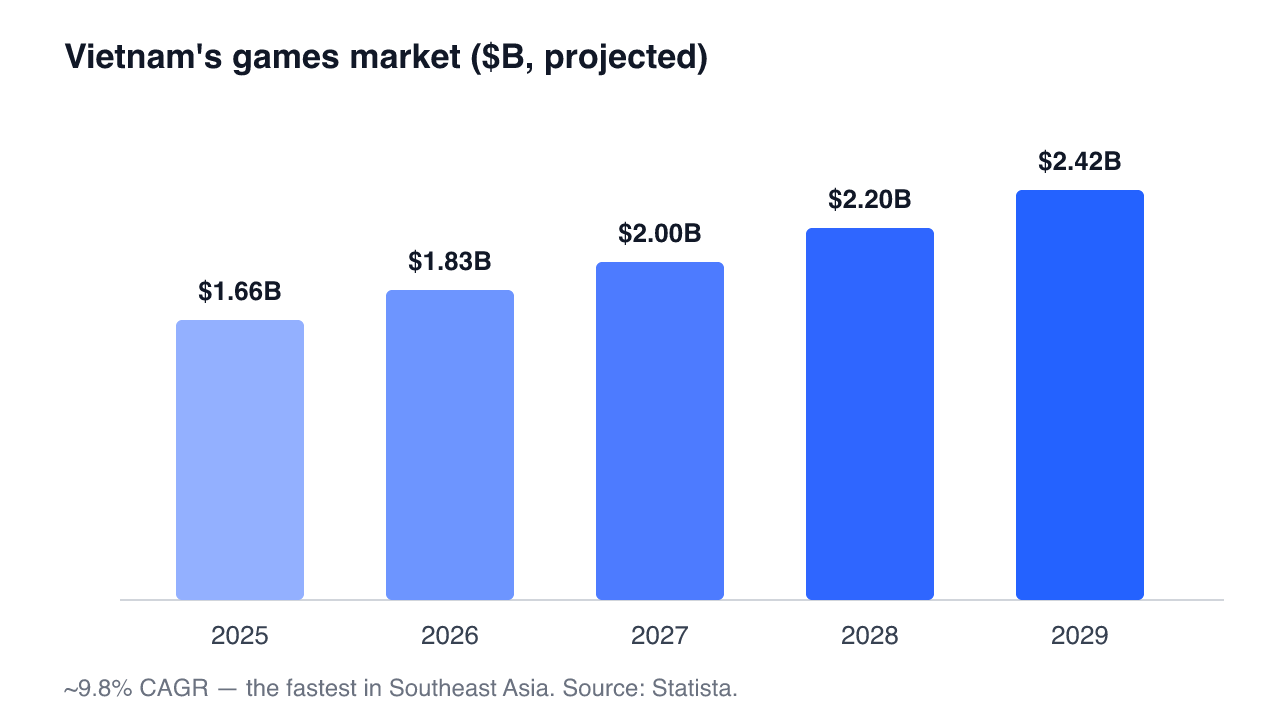
Vietnam's total games market, 2025–2029 (projected). Source: Statista — roughly 9.8% CAGR, the fastest in Southeast Asia.
So the demand is there, and it's sticky. Now the question is how you reach it.
Why low latency to Vietnamese players means hosting in-country
Not every game is latency sensitive in the same way. While turn-based titles will likely feel fine served from Singapore, real-time MOBA type games are a different story.
Vietnam players served from Singapore requires every input to cross a border and ride the same subsea cables the whole country leans on — five systems that fault roughly 15 times a year, and that in early 2023 failed almost all at once. Here, unstable international latency is something you plan around, not an edge case you can wave off.
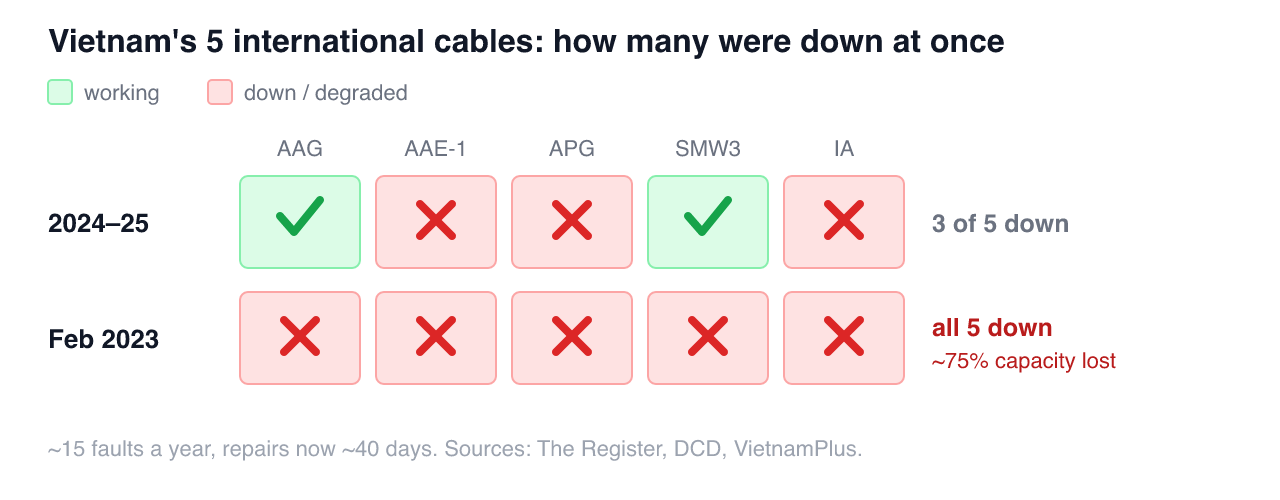
Vietnam reaches the world through five subsea cables. In the 2024–25 stretch three were down at once; in early 2023, all five, cutting roughly 75% of the country's data capacity. Sources: The Register, DCD.
A server inside Vietnam sidesteps it entirely: sitting on the national exchange (VNIX) and the carriers players already use, it keeps the whole path domestic.
Do foreign games (really) need a license in Vietnam?
The reality is plenty of foreign games run in Vietnam right now with no local footprint at all. It's been the case for many years where players simply downloaded global titles and connected to regional servers, usually in Singapore. What's changed is Decree 147, which is steadily closing that gap. Regulators can now compel the app stores to pull unlicensed titles, therefore driving foreign publishers are toward local builds. PUBG Mobile, for example, already runs a separate Vietnamese version.
For server-based multiplayer games that sit squarely under the rules, the practical takeaway is short - operate through a local entity and keep at least one server in the country.
How to host game servers in Vietnam
The build is straightforward:
- Both ends of the country. Vietnam is long and narrow, with its players split between the north around Hanoi and the south around Ho Chi Minh City. Covering the market means compute in both, not one node standing in for 1,600 kilometers.
- Domestic peering. Sit directly on VNIX and the major carriers, so traffic to players never spills back onto the international links.
- Headroom for attacks. Games draw more than their share of DDoS, so you want scrubbing built into the network with real capacity behind it.
- Virtual machines you can scale. Spin them up for a launch or a live event and wind them back down after, running match servers, matchmaking, live-ops, and accounts on one stack.
That is what we run in Vietnam. We keep points of presence in both Hanoi and Ho Chi Minh City, each offering Elastic Compute on the domestic carriers through VNIX, with network-level DDoS protection.
When hosting in Vietnam is worth it
If you're still weighing whether Vietnam is worth the effort, the thing to avoid is the middle path. Vietnam isn't a region you toggle on as you pass through Southeast Asia. It's the fastest-growing games market in the region. So if you're seeing real traction, build for it.