
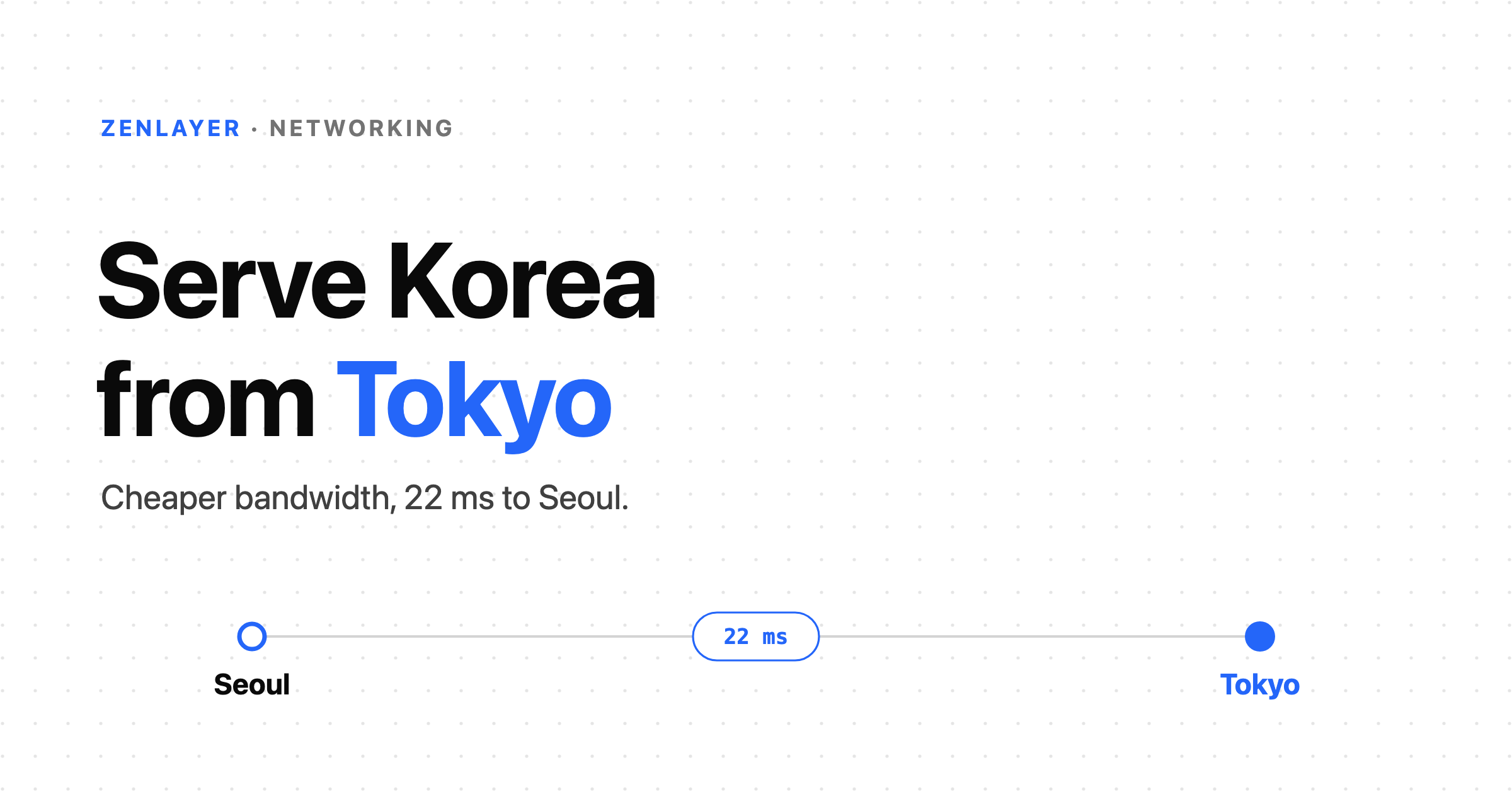
If you're deciding where to host to reach users in South Korea, hosting in Seoul seems like the obvious call. For a lot of workloads, it's the wrong one.
South Korea has some of the most expensive bandwidth in the region. Tokyo sits about 22 ms from Seoul, so the cheaper move is to serve South Korean users from Japan. Tokyo covers Japan and Northeast Asia from one base, at a bandwidth cost that hosting inside South Korea struggles to match. Here is when that works, and when it doesn't.
Why serving South Korea from inside South Korea costs more
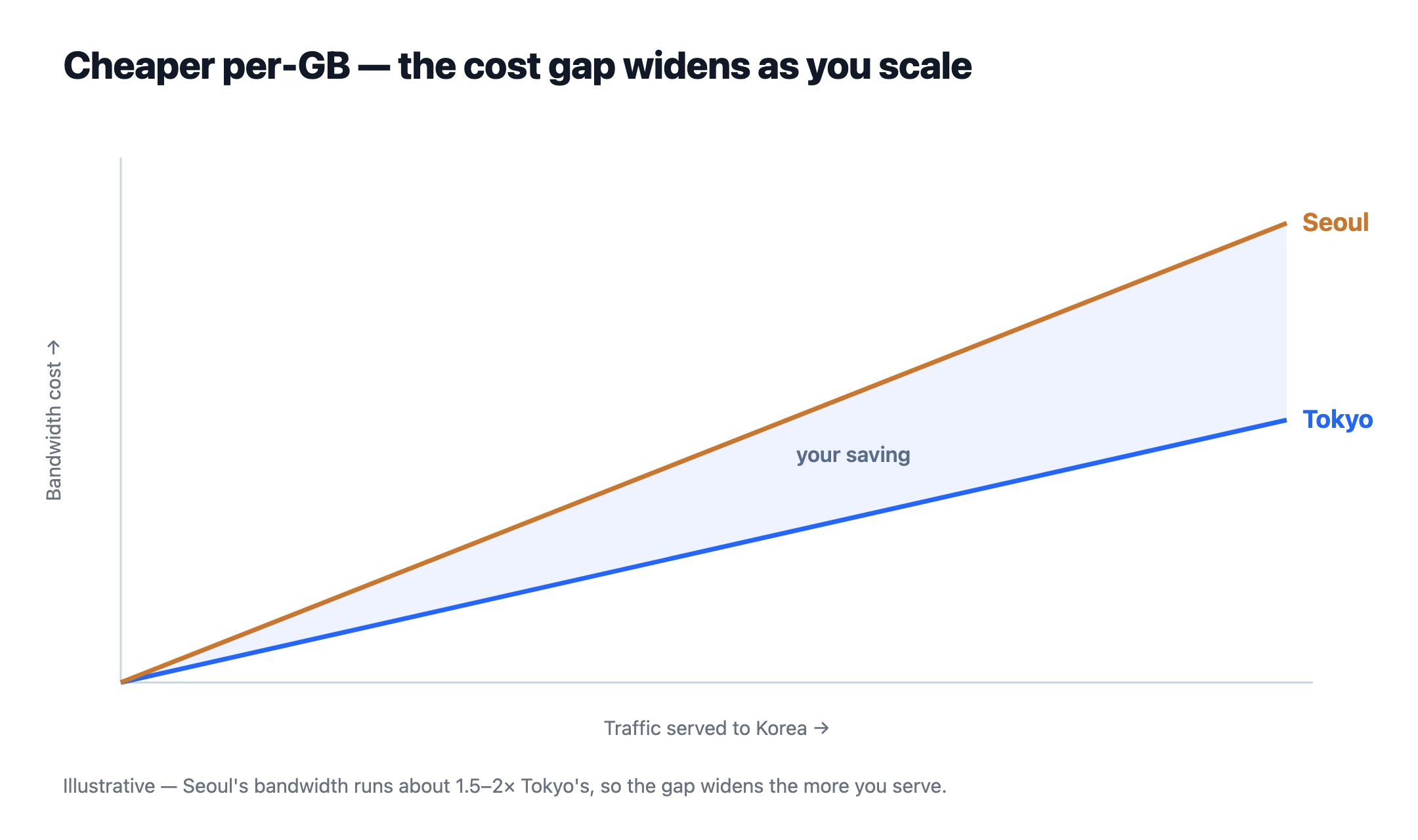
South Korea's interconnection rules make delivering traffic from within the country expensive. Local networks charge content providers to push traffic onto them — a "sending party pays" regime found in almost no other major market — so bandwidth in South Korea carries a structural premium. For anything bandwidth-heavy, that premium adds up fast.
Japan doesn't work that way. Bandwidth in Seoul runs roughly 1.5× to 2× what the same capacity costs in Tokyo. That gap is why content platforms cover South Korean users from Japanese infrastructure instead of standing up their own footprint in South Korea. On Zenlayer's Tokyo bare metal the bandwidth is unmetered, so the saving holds as your volume to South Korea grows.
Tokyo reaches South Korea at low latency
Over Zenlayer's private backbone, Tokyo sits about 22 ms from Seoul. That's close enough that South Korean users served from Tokyo get a path that feels local for everything short of the most latency-sensitive real-time work. Pair that with Japan's cheaper bandwidth and Tokyo becomes the efficient way to cover South Korean and Japanese users from one place.
Who Tokyo is the right base for
Tokyo fits when:
- You serve South Korean and Japanese users with bandwidth-heavy content — video, streaming, game updates, CDN origins.
- You run an AI-powered app or API serving South Korean and Japanese users — keep the user-facing app and content tier in Tokyo, cheap and 22 ms away, while the heavy GPU compute runs wherever it lives.
- You want one base for both instead of separate Japan and South Korea footprints.
- Bandwidth cost is a real line item.
The one case it doesn't cover: if you need to be physically inside South Korea for data residency, compliance, or the last few milliseconds of real-time latency. For everything else where South Korea and Japan are the audience, Tokyo is the more efficient base.
Why Zenlayer Tokyo
- Regional peering and transit. Tokyo peers at JPIX, JPNAP, and BBIX Tokyo and takes Tier-1 transit from NTT Communications, SoftBank, KDDI, and IIJ, for strong routes across Northeast Asia.
- A private backbone with failover built in. 1,620 Gbps of capacity, and Osaka 8 ms away on a separate path if a Tokyo-region event takes the primary route down.
- Measure it yourself. Run PING, MTR, and BGP checks from Tokyo to Seoul with Looking Glass before you move a workload.